Friday, February 7, 2025

7 February 2025 - guilty conscience


Herod was the one who had John arrested and bound in prison
on account of Herodias,
the wife of his brother Philip, whom he had married.

Herod was an archetypal example of the way in which sin tends to make one stupid. He knew John the Baptist to be a righteous man but put him in prison to make it easier for him to pursue his poor lifestyle choices. He liked to listen to John the Baptist speak. But the truth contained in his words could not penetrate past Herod's commitment to Herodias. At that point it was just matter of ignoring that which had the ring of truth for the sake of satisfying his emotions. But, as often happens, it got worse.

Herodias harbored a grudge against him
and wanted to kill him but was unable to do so.

The sacrifices required to sustain sinful life choices often not only increase but compound. It wasn't that Herod wanted to kill John. In fact he knew better. But Herodias was even more incensed at John's condemnation of their marriage and that was not a fact tht Herod could ignore. As when, with a lie, one often must keep telling more lies to justify the first, so here, where the first sin required more and more to continue its pursuit.

His own daughter came in and performed a dance
that delighted Herod and his guests.
The king said to the girl,
"Ask of me whatever you wish and I will grant it to you."

We may speculate that Herod was weakened into this sorry state where the merely sensual dance of a girl made him promise her up to half of his kingdom. If he hadn't been used to being led by his emotions but instead directed the course of his life based on truth he might have had some tolerance built up which could have prevented him from saying something he would later regret. As it was, he said it, and once he realized what the consequences would be it could not be unsaid without his pride being undermined. It was, after all, a boast stemming from pride that made him offer so much to begin with. This was merely the last in a series of things which he did not really want to do, which he in fact new better than to do, and yet did regardless because of that initial sin. He was deeply distressed, yes. But he went along with it nonetheless.

But when Herod learned of it, he said,
"It is John whom I beheaded. He has been raised up."

When Herod heard about the ministry of Jesus his guilty conscience made him imagine John the Baptist, whom he beheaded. But there was something more, perhaps, than psychological distress at work here. For Jesus was present within all of his persecuted saints. Just as Saul discovered that it was in fact Jesus whom he was persecuting, so too was Herod having something of that experience. And the point of an experience such as that is not merely that one is losing one's grip on reality. It contains an opportunity to repent and to recognize Jesus as Lord. Could Herod have done this, perhaps even on his deathbed? Certainly we have no biblical evidence of such a thing. But as Christians we may hope.

If we remember the confidence that we are meant to have in God and in Jesus we will be less likely to chase money or pleasure or other sinful behavior to the self-destructive degree that Herod did. The author of the Letter to the Hebrews reminds us that, "he has said, I will never forsake you or abandon you" (quoting Deuteronomy 31:6). If we remember this we won't give away the royal identity we have in Christ, no squander the portion of the Kingdom entrusted to our care.


Thursday, February 6, 2025

6 February 2025 - elements of discipleship


Jesus summoned the Twelve and began to send them out two by two
and gave them authority over unclean spirits.
He instructed them to take nothing for the journey but a walking stick

What does Jesus ask of his disciples? In today's Gospel we can observe a few elements which were likely important, not only for this early mission of the disciples, but for all disciples in all generations.

The first element is that he sent them out two by two, meaning he desired that they be able to work together and cooperate. In some ways this might seem inferior, since if they went out alone they could cover more ground. But, as going alone is always a recipe for disaster in horror movies, so too is it a bad practice for disciples. The reason for this can be discerned from the fact that Jesus gave them his authority. Working together with another tends to ensure that each helps the other remember the mission priorities when either is tempted to forget. Without this pairing of partners it would have been much easier to forget that they were not meant to wield their own authority or walk in their own power. But together meant that they would less easily take everything on their own shoulders and be more likely to remember Jesus and his instructions.

The second element is that he sent them out without what they might have considered adequate preparation. They went with next to nothing on their journey. This made them more dependent on God, but also more interdependent on those to whom they went to proclaim the Gospel. They were dependent on others for their hospitality, and God's providence to ensure that, even if a place did not welcome them or accept them, their integrity was preserved and they were able to move on. The point of this second element is not so much that we should immediately divest of all of our precautions, preparations, or possessions. Yet it is nevertheless probable that Jesus will occasionally desire to see how we fare without them and put us in situations where we either can't make use of them or where they can't help with the specific problem at hand. When we can't access this merely human sphere of preparedness we shouldn't try not to be discouraged but to look to Jesus, seeing ourselves as in similar shoes to these first disciples.

When we work together, relying on the resources of Jesus more than ourselves, we too may have to become effective disciples, bringing the authority of Jesus to bear in a world that is ever increasingly in need.

No, you have approached Mount Zion
and the city of the living God, the heavenly Jerusalem,
and countless angels in festal gathering

It is to this heavenly gathering that we draw near every Sunday and in fact everytime we participate in the mass. But as long there are many who are yet unaware that Wisdom has set her table we still have work to do. The disciples didn't have to be strong or competent to accomplish this work and neither do we. We need only be faithful.

Wednesday, February 5, 2025

5 February 2025 - blind spots


The saying goes that familiarity breeds contempt. This appeared to be true in the case of Jesus returning to his native place of Nazareth, and then, to the eyes of his neighbors at least, taking center stage and acting like a big shot.

They said, “Where did this man get all this?
What kind of wisdom has been given him?

In terms of response, they seemed to hovering somewhere between being impressed and being dismissive. On the one hand Jesus astonished everyone who heard him with his words. But on the other, this was Jesus, the one they knew, who had grown up in their midst. In their eyes there was just no chance that he was now a great teacher or healer. Even if something about him now seemed impressive, and his words astonishing, knowing what they knew, they assumed it must have been a trick. They let their preconceptions based on Jesus' past guide their interpretation of the present encounter, rather than reality.

Is he not the carpenter, the son of Mary,
and the brother of James and Joseph and Judas and Simon?

They thought they knew Jesus, but the only knew something of his humanity. They even appeared to make a veiled insult by referring to his mother without mentioning his father Joseph. In insulting him in this way they unintentionally did recognize his divine origin without realizing it. Jesus would later say, "blessed is the one who takes no offense at me" but these individual "took offense at him". He tried to provoke them to reconsider by stating that many of the prophets had had this experience, where it was precisely in the places that they were the best known that they were the least respected. Jesus was the culmination of the rejection of all of the prophets and so it made sense that he would also experience this.

So he was not able to perform any mighty deed there,
apart from curing a few sick people by laying his hands on them.

The people of Nazareth had previously been astonished at the words of Jesus, but now Jesus was amazed at their lack of faith. He did, after all, have the right to expect faith from them, them above most others. After all, those who knew him and had been in any kind of relationship to him ought to have been the most willing to give him a fair hearing with an open mind. But fortunately, this largely negative response was not reflective of everyone. He was still able to cure a few people, no doubt planting seeds that could change the prevailing attitude about him in the future.

We too have an issue where familiarity leads us to make assumptions, preventing us from hearing from God is trying to tell us hear and now. It is probably easier to learn a lesson from Father Mike Schmitz or Bishop Barron than our local pastor, even though the later is more likely to have an anointing meant specifically for us.

Let us learn from Jesus to not grow discouraged by trials. They are God opening pathways of growth. Let us press on, seeking "peace with everyone, and for that holiness without which no one will see the Lord" so that no one be deprived of the grace of God. This means we must be motivated to make sure we have no blind spots so that Jesus can reach us when and how he desires.


Tuesday, February 4, 2025

4 February 2025 - interruptions?


Seeing him he fell at his feet and pleaded earnestly with him, saying,
“My daughter is at the point of death.
Please, come lay your hands on her
that she may get well and live.”

The synagogue official approached Jesus with faith and begged him to come to save his daughter. This seemed like an admirable petition, well made. But often when we make such petitions isn't it the case that, from our perspective, they appear low on Jesus' list of priorities? This can be especially difficult when Jesus does initially start heading in our direction and then seems to get distracted with this or that other and more urgent task.

There was a woman afflicted with hemorrhages for twelve years.
She had suffered greatly at the hands of many doctors
and had spent all that she had.

How difficult it must have been for Jairus to hesitate for even a moment when his daughter's life was on the line. Nevertheless, Jesus paused to confirm the faith of the woman afflicted with hemorrhages for twelve years. Her touch of faith had unleashed healing. And Jesus wanted to build on that by establishing relationship, leading her to confess what she had done, and the blessing she had received. Jesus knew, as Jairus could not know, that there was time for this as well.

Disregarding the message that was reported,
Jesus said to the synagogue official,
“Do not be afraid; just have faith.”

Sometimes we have overly specific expectations for how Jesus will act. We want to see someone healed, but his priority is to see them resurrected. Often the ways in which God's timing do not match our own allows greater goodness to be unleashed leading to greater faith. Or at least it does if we don't give up when the messengers arrive to tell us it is hopeless, a lost cause. Even if our expectations of Jesus have limited him to solving a problem in one way that is now closed, if we remain open he may show us something better still.

He took the child by the hand and said to her, “Talitha koum,”
which means, “Little girl, I say to you, arise!”
The girl, a child of twelve, arose immediately and walked around.
At that they were utterly astounded.

At the end, once all is resolved, it is easy to point out that had Jairus and Jesus not been interrupted the miracle would have been something substantially less miraculous. Jairus, had he been asked, would probably never would have signed up for this more amazing and unexpected outcome. But we can be sure that, having seen what he had seen, he wouldn't trade it. 

God's timing is seldom our timing. But it important not to give up and go home with the neigh sayers. We haven't reached the end of the story yet. We have only seen the beginnings of the power of Jesus and how he can bring good even from the most apparently hopeless of circumstances.

let us rid ourselves of every burden and sin that clings to us
and persevere in running the race that lies before us
while keeping our eyes fixed on Jesus,
the leader and perfecter of faith.


Monday, February 3, 2025

3 February 2025 - restored


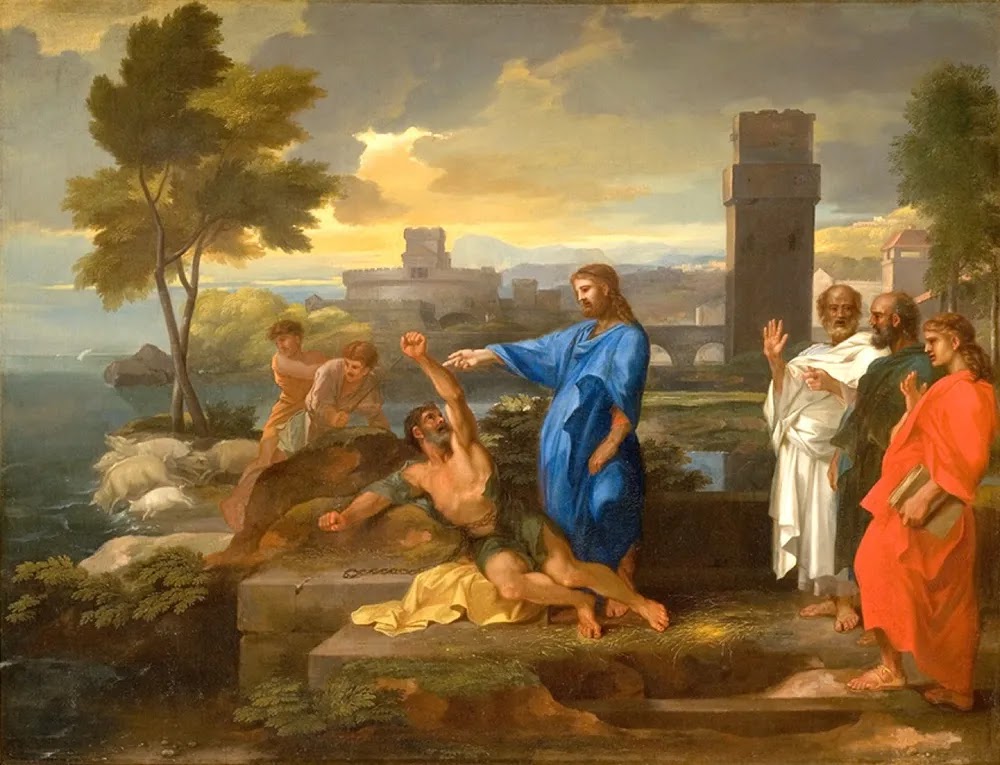
The man had been dwelling among the tombs,
and no one could restrain him any longer, even with a chain.

Sin makes one prone to self-destructive behavior. To an extent, society can help restrain such ones from anything too extreme. But there is only so much that most others are willing to do. They are often willing to help at first, but less so when it exposes them to danger themselves. And ultimately it is often a problem beyond their scope, wherein restraining the evil only delays the eventual recurrence of the behavior. Society can't address the forces that reduced an individual such as this to such a state. Such forces are not merely economic or psychological, but spiritual. And these are often sins in which society itself is complicit, even as it attempts to mitigate its most unsightly effects.

Now a large herd of swine was feeding there on the hillside.
And they pleaded with him,
“Send us into the swine.  Let us enter them.”

Legion was apparently tied in some way to the surrounding geography. It desired to express its identity by causing harm in that area and that people rather than another. If it was going to be cast out from a person it would settle for a herd of swine. If it couldn't hurt the man it formerly possessed directly, causing problems where he lived was a sufficient backup plan. 

The herd of about two thousand rushed down a steep bank into the sea,
where they were drowned.

Jesus, for his part, was interested primarily in healing the afflicted human person. He did not show much concern for the destabilizing effect the loss of the swine might have had on the local economy. Rather, he was content, for now, to see the man who been possessed "sitting there clothed and in his right mind". They were still in a place among tombs, with a drowned herd of unclean animals nearby. But none of these things was enough to be able to prevent the healing and restoration Jesus gave to the man who needed him. 

Then they began to beg him to leave their district.

We see from the fact that they begged Jesus to leave that they seemed to prefer the comfort of the old normal to the invasive and unsettling elements of the healing power of Jesus. Their swine economy was functioning perfectly well until he disrupted it. What was one human casualty? Well, to Jesus, one such casualty was everything. 

“Go home to your family and announce to them
all that the Lord in his pity has done for you.”

In this call from Jesus to the formerly possessed man we see the way in which Jesus typically goes about changing systemic issues in society. He first sets free individuals, makes them his witnesses, has them continue to live among the people they knew in the places they were from, and, as a consequence, their transformed lives begin to change the world around them as well.

Then the man went off and began to proclaim in the Decapolis
what Jesus had done for him; and all were amazed.


Sunday, February 2, 2025

2 February 2025 - presentation tense


This man was righteous and devout,
awaiting the consolation of Israel,
and the Holy Spirit was upon him.

Simeon was part of the holy remnant, people still awaiting the consolation of Israel by God, promised through prophets such as Isaiah (see Isaiah 40:1-2). Most other people simply accepted the new normal of sadness, sin, and sorrow. Maybe they briefly heard about the prophetic hope of Israel but then lost touch with it due to cynicism arising from daily life. Simeon lived in the same Roman occupied world that made others cynical but he did not lose hope. Simeon believed God would really bring about a time for Israel when her warfare was ended and her iniquity was pardoned.

Simeon's good spiritual posture, his history of heeding the Holy Spirit, might have been part of the reason he was able to witness the fulfillment of that hope in the presentation of Jesus in the temple. Not to say that he had made himself worthy of the honor. More that other people were too busy and too distracted by daily life to be available. God wanted to give the blessing, at least in this case, to someone who could really appreciate it. He wanted to respond to longing with fulfillment, for Israel in general, and Simeon in particular.

Now, Master, you may let your servant go 
in peace, according to your word,

Simeon considered his life a success simply because he was able to see and hold in his arms the salvation prepared by God in the sight of all peoples. He said, effectively, that there was nothing else he needed, nothing more he needed to do. He could die happy having just this one thing.

a light for revelation to the Gentiles,
and glory for your people Israel.

What Simeon saw and recognized was not something that was so obvious to others. Jesus was a light to those looking for the light. He was glory for those who hadn't squandered their hope of glory. Of course, God also had ways to reach out to those who didn't know their need for a savior. But this morning, we who know our need are encouraged to lean into our desire, to stake upon it all that we have and all that we are, as Simeon did.

She never left the temple,
but worshiped night and day with fasting and prayer.
And coming forward at that very time,
she gave thanks to God and spoke about the child
to all who were awaiting the redemption of Jerusalem.

Most people in Anna's situation might have assumed they had forgotten by God. But, by fasting and worship, Anna remained attuned to God. Most people would have assumed that their purpose was mostly in the past after living so long as a widow. But Anna's attentiveness to God allowed her to be something of a sleeper agent, waiting to be activated when God had need. She took on the role of one of the first evangelists as she tried to help other visitors to the temple understand what was the big deal that all but floored Simeon.

Just what was it that Jesus came to bring that Anna and Simeon found so worthy of hope?

that through death he might destroy the one
who has the power of death, that is, the Devil,
and free those who through fear of death
had been subject to slavery all their life.


Saturday, February 1, 2025

1 February 2025 - asleep in the boat


Leaving the crowd, they took Jesus with them in the boat just as he was.

Taking Jesus with them "just as he was" was the right approach. We often try to change Jesus in some way before we let him use our boat. We often prefer a Jesus who is more 'as we are' than as he is, and allow our preferences about him to obscure the reality of his person. But isn't it really the real Jesus we want, rather than the one we invent? Because if it comes down to us and our ideas and our cleverness won't this just be one more thing that comes up short, like so many good ideas before it?

A violent squall came up and waves were breaking over the boat,
so that it was already filling up.
Jesus was in the stern, asleep on a cushion.

Life with Jesus does not promise an absence of storms. But although the disciples who encounter storms in the Scriptures are never that far from Jesus he doesn't ever seem to be where they expect him to be or do what they expect him to do. This leads to confusion, which is OK, but not to despair, which wouldn't be. The storms in our own lives will probably be in some way similar to these Scriptural storms. Jesus will be present with us throughout, but not in the way that we would have guessed or that we would have found most comfortable.

Teacher, do you not care that we are perishing?

This was a question very close to despair. But that would have been a slightly different question, more assured of its own insight, 'Teacher, why don't you care that we are perishing?'. Rather, they left open the possibility in their minds that he did in fact care and that there was in fact still good that could come from the difficult situation.

Then he asked them, “Why are you terrified?
Do you not yet have faith?”

We begin to wonder how many times we're going to have to ask ourselves this question after Jesus proves himself trustworthy again and again. It is almost as though the Enemy tries to prevent us from remembering past victories such that each new problem feels completely overwhelming. No, wait, that is in fact what is happening. If we aren't careful to be thankful and treasure the Lord's blessings in our hearts we will be back to the drawing board for each new difficulty.

They were filled with great awe and said to one another,
“Who then is this whom even wind and sea obey?”

A cynic would say that Jesus should have prevented the storm in the first place. But had he done so they would not have experienced this invitation to a deeper faith. The were beginning to see in Jesus, not only a miracle worker, but even God himself in human form. And that, like it or not, is sometimes something we can only get by going through the storm with him.