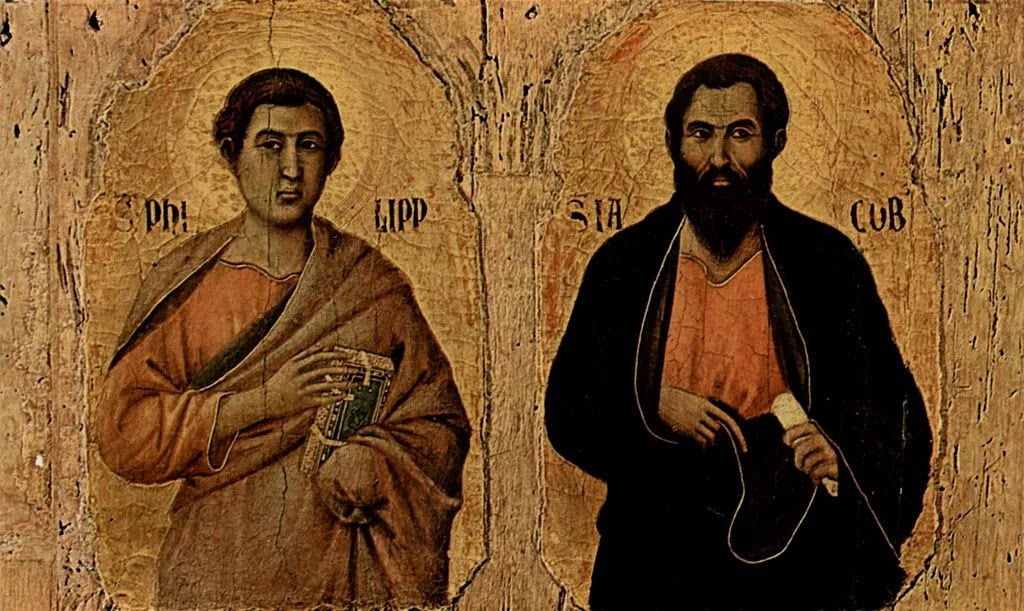
But I told you that although you have seen me,
you do not believe.
Just to see is not enough. One must see and believe. And this is not inevitable. Some saw Jesus and the signs he performed and were moved to faith. Some saw Jesus and his signs and yet did not believe. They did not understand the signs they saw. Their gaze did not penetrate beneath the superficial. They did not consider things in terms of true origin and destiny, the reason why things were, and for what they were made. Instead, they were caught up in the world of the ephemeral. They saw bread, and briefly thrilled, considering only the potential for unlimited effortless food. They saw Jesus, and may even have found him interesting, but still only regarded him in terms of his supposed human origin in Nazareth. The gift of the bread was meant to be a sign that was supposed to point to the one who gave true bread from heaven and the one who was himself that bread. It pointed to the true origin of Jesus in the heart of the Father, and to his true purpose in coming into the world. This bread was not about physical satiety, but spiritual, such that "whoever comes to me will never hunger, and whoever believes in me will never thirst".
Everything that the Father gives me will come to me
They were invited to let themselves be drawn by the Father and so come to faith in Christ, just as Peter received his revelation about Jesus, not from flesh and blood, but from the Father (see Matthew 16:17). In this responding to this, they would, as Jesus said, accomplish the work of the Father by believing in the Son, since it would be the work of the Father within them.
and I will not reject anyone who comes to me,
because I came down from heaven not to do my own will
Jesus didn't come only for some, for an arbitrarily chosen demographic, or a randomly selected population. He came for anyone who would come to him. He would receive all of those who did in fact hear and respond to the invitation that he gave to all those who labored and were heavy laden (see Matthew 11:28-30). Those who heard the invitation were expected to reply. But those who did not hear it but would have come if they had would not necessarily be rejected as long as they followed such light as they were given. We have a hard time being so all inclusive in our invitation to others and our willingness to welcome them. We still have too much desire to do our "own will", isolated and apart from the heart of God. We want to welcome those who are in some way convenient or expedient for us, those who will increase our profits or bolster or self-image. But coming to Jesus means imitating him in his humility, which means growing in our ability to love others without such egocentric boundaries.
And this is the will of the one who sent me,
that I should not lose anything of what he gave me,
but that I should raise it on the last day.
God desires all to be saved and come to knowledge of the truth (see First Timothy 2:4). And the promise of Jesus is that he will do his part. No one who comes to him will be lost on his account. They will not be able to say that he didn't provide sufficient grace or that he presented them with insurmountable challenges. Of the challenges and trials we may face Paul wrote, "God is faithful, and he will not let you be tempted beyond your ability, but with the temptation he will also provide the way of escape, that you may be able to endure it" (see First Corinthians 10:13). Of God's commitment to the ongoing project of each of our lives Paul wrote, "I am sure of this, that he who began a good work in you will bring it to completion at the day of Jesus Christ" (see Philippians 1:6).
The only way to sabotage salvation is ultimately self-sabotage. But even this Jesus will go to all possible lengths to prevent. He wants to spend eternity with us to such a degree that our refusal is the thing that most saddens his Sacred Heart. We saw this in his lament over Jerusalem, when he said, "How often would I have gathered your children together as a hen gathers her brood under her wings, and you were not willing!" (see Matthew 23:37).
Now those who had been scattered went about preaching the word.
Though it is grave to reject the invitation of Jesus it is not final, not while this life lasts. God can bring good even out of our refusal. But let us allow this good to avail for us, so that the Father's work can be truly accomplished in and around us.
Wednesday, May 7, 2025
7 May 2025 - all that the Father gives
Tuesday, May 6, 2025
6 May 2025 - bread of angels
What sign can you do, that we may see and believe in you?
They had seen the sign of the multiplication of the loaves, and this led them to suspect that Jesus might be the prophet like Moses, the one whom Moses had promised would one day come. But Jesus himself had told the crowd that they weren't really pursuing him because they had understood that or another of his signs. They were pursuing him because they desired easy access to more bread, even if it was of the kind that would leave one hungry again eventually. They were caught up in the cycle of apparent necessity. The were willing to go that far with Jesus, but not further. Having been called out on their own motivation, rather than looking within themselves, they critiqued Jesus. He seemed to be acting as if he were even greater than Moses, the one, among all others, on whom "the Father, God, has set his seal". After all, even the food given through Moses perished, but Jesus pointed to food that endures for eternal life.
Our ancestors ate manna in the desert, as it is written:
He gave them bread from heaven to eat.
The crowd suggested that the feat of feeding Israel in the desert for forty years far surpassed the multiplication of the loaves and fishes that Jesus had accomplished. Therefore, they implied, he was not even on the same level as Moses, let alone someone greater.
Amen, amen, I say to you,
it was not Moses who gave the bread from heaven;
my Father gives you the true bread from heaven.
The crowd had been arguing in a way that implied they thought that it had been Moses who gave them bread in the wilderness through his own innate power. Thus, they reasoned, he was greater than Jesus. Therefore Jesus clarified their misconception. It was not that the miracle in the wilderness was proof of the greatness of Moses. It was in fact a sign of the mercy and providence of the Father. For this reason, it was not a competition between the works of a dead prophet and a living one. It was a continuity in God the Father demonstrating his love for the world.
For the bread of God is that which comes down from heaven
and gives life to the world.
If it had been done by Moses, the bread in the desert would have been a past, one time event, and "gave" would have been the whole story. But because it was done by the Father, it continued then, and even now since the "Father gives", then and there, as well as here and now. Yet there was discontinuity as well, since those who ate the manna in the desert did eventually die. In the desert received bread that was like that which Jesus multiplied for the crowds. It was a sign or symbol of life, but not the thing itself. The true bread which God desired to give to the world was bread that was more fully life-giving. This bread was not only a symbol of life, but rather, life itself.
“Sir, give us this bread always.”
Jesus said to them, “I am the bread of life;
whoever comes to me will never hunger,
and whoever believes in me will never thirst.”
To their credit, the crowd recognized how desirable this bread was. It was as if their argumentativeness was stopped short against the goodness of what Jesus described. The true bread that came down from heaven was not manna, which was still in the end only earthly bread. The true bread that came down from heaven was the one who had come down from heaven by way of the incarnation, Jesus himself. But this centrality of Jesus contained both peril and promise. It meant that the only way for the crowd to find true satisfaction to their hunger and thirst was in Jesus himself. But the crowd was already having difficulty accepting one as great or greater than Moses. How would they receive one who demanded such absolute primacy in their lives? He was really promising something that only God himself could provide. And he said God the Father, was the one providing. But he himself was the thing given, bread for the life of the world. Looking anywhere else for fulfillment would lead inevitably to frustration.
How does the bread of life give us eternal life? It does so by conforming us to Jesus who is himself that bread. We become, it is said, what we receive. When we eat normal bread we assimilate it to ourselves. When we eat the Eucharist Jesus assimilates us into himself as his Body. We can see that we are meant to become images of Jesus, as Jesus himself was an icon of the Father, from the first reading about Stephen.
As they were stoning Stephen, he called out,
“Lord Jesus, receive my spirit.”
Then he fell to his knees and cried out in a loud voice,
“Lord, do not hold this sin against them”;
and when he said this, he fell asleep.
John Michael Talbot - I Am The Bread Of Life
Monday, May 5, 2025
5 May 2025 - bread stuck
Amen, amen, I say to you, you are looking for me
not because you saw signs
but because you ate the loaves and were filled.
This reminds us of children we have known, perhaps ourselves, whose primary motivation for attending mass, aside from parental command, was to indulge in the donuts offered after. That this is a problematic motivation is not subtle. But as we grow we become increasing adept at self-deception. We learn, perhaps slowly, that donuts are not the ultimate good for which we were made, that they can only provide fleeting and occasional happiness. But we don't necessarily start to work "for that food that endures for eternal life" exclusively. There are many other goods that are tangential or adjacent to religion that are easy to confuse with seeking God himself. We may come seeking to be entertained or to be near like minded people. We may desire to feel warm fuzzies that are something more banal and self-created than true spiritual consolation. What demarcates these things as food that perishes is precisely the fact that there is no real possibility for consistent upward growth. If we seek to be entertained, there are better options than the best homilist. If we seek like minded people, it may be much easier to find them on social media, or by joining a special interest group. If what was desire is good feeling there are many ways this can be manufactured more consistently than by a mass. But the more we invest ourselves in any pursuit over than the "food that endures" the more we will discover its inability to satisfy us.
Do not work for food that perishes
but for the food that endures for eternal life,
which the Son of Man will give you.
We tend to make a habit of drinking the water that will leave us thirsty again, rather than the living water offered by Jesus. We tend to prefer food that perishes, just because it is more readily available. Or so it seems. It is true that earthly things are definitely more subject to our control and manipulation, easier to summon forth in moments of need. Spiritual food transcends these earthly things and is not subject to childish whims. Like Jesus himself it is unpredictable to the earth directed mind, unpredictable in its coming and its going. As to Jesus, so too to the bread he offers do earthly people say, "Rabbi, when did you get here?". But it is possible for us to continue on the upward trajectory that may have started with donuts to seek with ever greater sincerity Jesus himself, and the bread that he gives. This means not getting stuck at the level of satisfying our impulses, but instead being guided by the signs with which Jesus manifests himself. It means not using our base desires as a key to understand Christianity but rather allowing Jesus himself to be our key. He is designated as the only one able to perform this role by the seal with which the Father, God, has healed him.
So they said to him,
"What can we do to accomplish the works of God?"
Jesus answered and said to them,
"This is the work of God, that you believe in the one he sent."
It seemed that they were beginning to realize the way in which their previous goals fell short. But they were still looking for an option that was in their purview or power. There was a way in which it was not a bad question, since the ultimate answer would needs be defined by God himself, since there were real works demanded of them. But the answer Jesus actually gave was almost frustratingly simple for those seeking a direct route to an imminent goal. 'Believe in Jesus? But what will that do?', they may well have wondered. Yet we at least ought to know the answer. Belief in Jesus leads to freedom from the tyranny of earthly and perishable things. It leads to eternal life, even to participation here and now in the life of God. It is from this belief that we have the basis for any works of true value; the faith, the hope, and the love, we need to truly accomplish the works of God.
Remove from me the way of falsehood,
and favor me with your law.
The way of truth I have chosen;
I have set your ordinances before me.
Jaime Thietten - I Am The Bread Of Life
Sunday, May 4, 2025
4 May 2025 - gone fishing
Simon Peter said to them, "I am going fishing."
They said to him, "We also will come with you."
Although they had seen the risen Lord and been given the Holy Spirit for the forgiveness of sins it did not necessarily preclude the necessity that they provide for their daily needs. After being called to leave their nets, at the beginning of their lives as disciple,s there was a clear and well defined center to their lives in the presence of Jesus himself. But after the resurrection Jesus was more unpredictable, appearing, as it often seemed, when they least expected it. Before his death they typically knew where he was and how to find he. But after the resurrection it seemed to be more often, if not always the case that it was he himself who found them. They probably did not know how to integrate that into their daily lives. They knew they were intended to carry out his mission and follow him. But that seemed much more ambiguous in the light of the mode of his resurrection appearances. Did they resort to fishing because they couldn't make heads or tails of what their commitment to Jesus now meant? Or was it merely a preparatory step along the way toward some more explicitly Christocentric goal?
So they went out and got into the boat,
but that night they caught nothing.
We can't help but feel that things would have been different somehow if they were more able to involve the risen Lord and their daily concerns. This is not to say that the presence of Jesus guaranteed perpetual success. But his presence was proof against long nights of lonely and isolated frustration. All of the feelings they might have experienced in the absence of Jesus, fault, failure, and inadequacy, could have been conquered by the peace that his presence conveyed. And it is a surety that disciples would meet whatever success Jesus intended them to have sooner by being attentive to his voice than otherwise.
When it was already dawn, Jesus was standing on the shore;
but the disciples did not realize that it was Jesus.
They felt that they had been alone in the boat. The longer the night dragged on without a catch they more their frustration grew, as well as the sense of the trip as a failure. But Jesus revealed himself at that particular moment in the morning to demonstrate that he was entirely aware of their plight, that it had not escaped his eyes. The consequence of this was that, if he had such knowledge, they need not have ever felt alone or abandoned. Even before he revealed himself in the morning they could have called to him in the night.
So he said to them, "Cast the net over the right side of the boat
and you will find something."
Doing life together with Jesus was always preferable to trying to do it alone. Even though the post resurrection world in which we live means we don't necessarily see him with our eyes it does not mean he has abandoned us. Like the disciples, we too have received his Holy Spirit. And like them, we are meant to listen to the guidance of the voice of Jesus conveyed to us by his Spirit. We may still have to live the same life and doing many of the same things we did before we knew the risen Lord. But they all receive an entirely new aspect when we do them in the light of his presence and his love. Even when we do go out alone into the night of frustration we know that we can still look to the morning and the appearance of Jesus himself, since, "Weeping may tarry for the night, but joy comes with the morning" (see Psalm 30:5).
So Simon Peter went over and dragged the net ashore
full of one hundred fifty-three large fish.
Even though there were so many, the net was not torn.
When we listen the the voice of the Lord our lives receive a unifying character, directed toward mission, and to the Kingdom. Even our preparation of breakfast can become, in turn, a preparation for evangelism. As we try to do life together with Jesus he becomes the central point where we bring both our insufficiency and our abundance, our joy and our sorrow, all of which he uses for the Kingdom. He himself desires that the Church be an untorn net full of fish of every kind. And he in turn uses fishers of all kinds to do his work. It is work we need never do alone since he is always watching and waiting on the shore. We will experience this presence ourselves, much as the disciples did, in a Eucharistic feast.
Jesus said to them, "Come, have breakfast."
And none of the disciples dared to ask him, "Who are you?"
because they realized it was the Lord.
Jesus came over and took the bread and gave it to them,
and in like manner the fish.
This was now the third time Jesus was revealed to his disciples
after being raised from the dead.
Darrell Evans - Trading My Sorrows
Ron Kenoly - Ancient Of Days
Saturday, May 3, 2025
3 May 2025 - scene: The Father
Jesus said to Thomas, "I am the way and the truth and the life.
No one comes to the Father except through me.
Many people aren't particularly interested in coming to the Father, because they have misconstrued the Father's heart. They take him to be sometimes absent, sometimes violent and vengeful, but only seldom merciful and loving. They focus on causes of fear rather than reasons to love and to trust. Closed hearts and minds darkened by sin are almost unable to see him differently. They claim to be looking for love, but are in fact only looking for the freedom of license. They say they desire justice and mercy, but themselves perpetuate the cycle of violence in our world. They see the Father reflected through themselves as other fallen men and women as a lens, and see only their worst aspects magnified.
If you know me, then you will also know my Father.
From now on you do know him and have seen him.
Jesus came to heal our distorted image of the Father by being himself the Father's perfect icon. Looking at him reveals the Father, and is corrective to all of the ways we tend to misinterpret him. He gives healing to our vision, helping us to behold that which matters most, which has the greatest ontological priority, God himself. Thus he himself is the way to the Father, is the truth about the Father, and conveys the life, which he himself receives from the Father, to us. And he is eminently approachable, meek and humble of heart. Yes, he shares the Father's heart for justice, and will himself judge the living and the dead. But what he wants is for us to come to him and find rest (see Matthew 11:18-30). He came into the world to offer us mercy and salvation, because that was also what his Father desires for us.
Philip said to him,
"Master, show us the Father, and that will be enough for us."
No doubt Philip already received some measure of healing just being near to Jesus and seeing the relationship that Jesus himself had with the Father. Jesus' relationship to the Father made Philip believe that just to catch a glimpse of the one to whom Jesus related with such intimacy and love would be enough to satisfy his soul, perhaps forever. He desired his own little piece of the unfathomably deep relationship between the Father and the Son. But he was still not quite looking in the right direction. It was as though he was trying to look past Jesus and find the Father, somewhere else, out there. But to truly access the vision of the Father that could satisfy him there was no where to look other than Jesus himself.
Jesus said to him, "Have I been with you for so long a time
and you still do not know me, Philip?
Whoever has seen me has seen the Father.
How can you say, 'Show us the Father'?
Do you not believe that I am in the Father and the Father is in me?
Once we come to believe that Jesus is in the Father and the Father is in him, every aspect, gesture, and word of Jesus becomes also a revelation of the Father. All of his teaching, his powerful, life-giving works, and especially his self-sacrificial love, all of these are a revelation of the Father's heart, the love with which the Father himself "so loved the world" (see John 3:16).
Amen, amen, I say to you,
whoever believes in me will do the works that I do,
and will do greater ones than these,
because I am going to the Father.
The disciples of Jesus would receive the power of the Holy Spirit to fill the entire world with powerful works that revealed the Father. Jesus himself was going to the Father with sending the Spirit as his stated purpose (see John 16:6-8), to continue his mission, and make his presence available in an ongoing way throughout generations. But this fact was not merely a tangent, related because of the concept of works. It flowed directly from the need to have our spiritual vision healed to see the Father and to desire to see him. The Spirit was the Spirit of Sonship, and thus distortions about God were potential impediments to his power being fully unleashed in our lives. After all, if the mission of Jesus was to reveal the Father, so too is the mission of the Spirit. And if we are not onboard with that mission ourselves how could we expect the Spirit to bear much fruit in our lives?
And whatever you ask in my name, I will do,
so that the Father may be glorified in the Son.
If you ask anything of me in my name, I will do it.
To ask in the name of Jesus is more than to merely say as much in words. It means asking in a way consistent with what the Son himself would ask, and indeed asking how the Son would ask, with patience and trust and love. But this does not mean that these petitions make no difference, as we might otherwise think since we cannot, after all, change the Father's heart. Rather, as we have recently seen and noted, the Father delights to pour out good gifts on his children. Sometimes he waits for us to ask just so that, in responding, we can come to a greater appreciation of his goodness.
Friday, May 2, 2025
2 May 2025 - loaving around
When Jesus raised his eyes and saw that a large crowd was coming to him,
he said to Philip, "Where can we buy enough food for them to eat?"
He said this to test him,
because he himself knew what he was going to do.
It may sometimes seem as though Jesus himself is asking us to solve problems that are beyond our capabilities. The implication of his question to Philip was that Philip ought to somehow figure out how they could purchase enough food to feed a massive crowd. It was almost as if he had been asked to take their meager resources and somehow make them sufficient for the need it hand. Almost. But that wasn't quite what Jesus had asked. Jesus knew that the problem couldn't be solved by their buying power. And Philip knew it as well. But Philip was distressed, apparently, to even consider it. His response to Jesus might have been intended to save himself from being assigned with an impossible task (after all, Jesus asked him specifically) or to let Jesus know that what he suggested was ridiculous to even consider.
Philip answered him,
"Two hundred days' wages worth of food would not be enough
for each of them to have a little."
One wonders if Philip would have faced any overwhelming problem in this way, by simply calculating, and then giving up. Maybe it was different in this case because he had been asked by Jesus, in a way that seemed to imply that the food could be purchased. Maybe this was what prevented him from relying on Jesus to solve the problem. Jesus wanted to how Philip would respond when he reached the limits of what he could do. He wanted to see, too, how Philip would handle a task such as this when it was apparently entrusted to him by Jesus. Would he try to handle it on his own, resulting in despair, or would he ultimately trust in Jesus to provide abundance and joy?
Andrew, the brother of Simon Peter, said to him,
"There is a boy here who has five barley loaves and two fish;
but what good are these for so many?"
The resources were insufficient. The best they could do by their natural calculations fell laughable short. But there was still something admirable in Andrew at least bothering to mention what they did have to Jesus, even if it was only five loaves and two fish. It seemed he thought these were likely to be useless. But why mention them if he was not at least entertaining the possibility that, in the hands of Jesus, they might somehow be good enough even for so many? He couldn't express the possibility. It seemed absurd to even put it into words. But reaching these limits as Philip and Andrew both did was part of the experience Jesus intended them to have. They weren't to handle the situation on their own with their own resources. But they were to make themselves and all that they had available entirely to Jesus. Jesus, of course, did not need to involve anyone. He who created the universe from nothing did not need bread of fish as the starting point of a magic trick. But he wanted his disciples to understand what it meant to stay connected to him as branches to the vine. He wanted to show them how even the most meager assets could yield an abundance as long as they were not held back from him. This meant that Philip and Andrew could only respond well to such a test from Jesus if they responded with humility. Humility meant that they owned up to their limits and liabilities and still presented what we have to Jesus. It did not mean despair over those limits, because that would keep them from Jesus and frustrate his plans.
Jesus said, "Have the people recline."
Now there was a great deal of grass in that place.
Jesus was the good shepherd, making his people to lie down in green pastures, filling the hungry with good things. And he continues to shepherd his Church even today. He continues to look upon those who are physically or spiritually hungry with eyes of compassion. And it is clear that he longs to involve his disciples in bringing others to him to be fed. This is true in one way of clergy and religious and in another way for the laity. But it is true of everyone. It is not as though the laity are meant to only address physical needs while the clerics attend to the spiritual. Rather, clerics are meant to encourage, united, and direct the laity in their efforts to transform society. And the laity in turn are meant to help invite others to join them around the table of the Lord. Obviously both aspects of the challenge appear basically impossible in our day. The selfishness of men seems to preclude the possibility that the poor will ever receive sufficient sustenance. The world doesn't seem ready to even listen to the possibility that Christianity might have answers to the deepest questions that arise in the souls of men and women. Without having heard it what it proposes they assume they already know everything it might say. And yet, in the face of these, and many other challenges, Jesus has enough. Our resources are not enough. Not alone. But in his hands they can feed the world.
So they collected them,
and filled twelve wicker baskets with fragments
from the five barley loaves that had been more than they could eat.
Thursday, May 1, 2025
1 May 2025 - don't ration-alize
The one who comes from above is above all.
The one who is of the earth is earthly and speaks of earthly things.
But the one who comes from heaven is above all.
Those who are of earth tend to believe that the earthly is all there is, and that, even if there is more it is beyond the understanding of mere creatures. Even if there was more to reality than the physical and the empirical, how, after all, would we know it? Ought not we behave like the psalmist who wrote, "O LORD, my heart is not lifted up; my eyes are not raised too high; I do not occupy myself with things too great and too marvelous for me" see Psalm 131:1)? Yet what if there was someone who, by his nature, knew all of these mysteries and could speak about them with authority? Even then we would want to avoid mere curiosity. But what if those things which we could not know naturally were things that we nevertheless needed to know?
He testifies to what he has seen and heard,
but no one accepts his testimony.
Whoever does accept his testimony certifies that God is trustworthy.
For the one whom God sent speaks the words of God.
We are meant to know more than merely earthly things, the time bound and the temporary. Our horizon is meant to be more expansive than things which will all eventually perish. And learning of these heavenly things is not only not optional, not only important, but vital and necessary. To disregard the message is to disregard the messenger, which is to demean God who is himself the source and guarantee of the truth of the message. We must not tell God that we don't believe him or that we don't care what he has to say. God has no need to teach us anything. But we are in desperate need of his teaching. We were made for more than this earth. We were designed for a heavenly destiny, intended for a relationship with God himself. But only the one from heaven, Jesus, can reveal the Father to us. Thus the heavenly teaching in question is not merely esoteric facts or data. It is rather experiential and personal. It is not communicated by the firing of synapses so much as it is by the fire of the Spirit.
He does not ration his gift of the Spirit.
The Father loves the Son and has given everything over to him.
Jesus received the gift of the Spirit without measure from his Father. But he in turn delights to pour out that gift upon us. That gift, the Spirit, is a "Spirit of wisdom in revelation in the knowledge of him" in order that we "may know what is the hope to which he has called" us and the full promise of our heavenly inheritance (see Ephesians 1:16-18). We tend to believe, at least subconsciously, that God is stingy, that he is reluctant to give good things to his children. But we can see in the fact that Jesus himself has received the Spirit without measure that there is also no upward limit to how much we may hope to receive. And this in turn can reinforce our trust in a Father who delights to give good gifts to us, his children.
If you then, who are evil, know how to give good gifts to your children, how much more will the heavenly Father give the Holy Spirit to those who ask him! (see Luke 11:13).
The gift of the Holy Spirit is not merely a nice to have, not an optional extra for super Christians or Jesus Freaks. His presence in our lives means more than feeling like water walking, glow in the dark, wonder workers, and definitely means more than entertaining ourselves at prayer meetings, however good those may be. He may well mean all of that too. But the principle aim of the Spirit is to unite us to the Son in his own relationship to the Father. This is why it is so vital to believe the revelation of the Son about the Spirit. Because if we don't respond to that revelation there is no way to reach the eternal life that God intends for us.
Whoever believes in the Son has eternal life,
but whoever disobeys the Son will not see life,
but the wrath of God remains upon him.

.jpg)